
Updated August 2026
I've been shooting photo and video in San Diego for years, and I still haven't run out of locations. That's the honest pitch for this city: within about 40 minutes of downtown you can frame ocean cliffs, Spanish Colonial architecture, mural-covered industrial streets, pine forest, and open desert. No other region in California packs that much visual range into one drive. This guide covers the locations I actually use for brand shoots, interviews, and short-form video — plus the permit reality nobody explains until you're mid-scout.
Beach and coastal locations
Sunset Cliffs (Point Loma)
The most reliable golden-hour location in the city. The cliffs face due west, so from about an hour before sunset the light rakes across the sandstone and the whole coastline glows. Two things to plan around: parking fills up fast on clear evenings, and the tide matters. At low tide you can get down to the flat rock shelves for water-level angles; at high tide those same spots are underwater or dangerous. Check a tide chart before you commit a client to a time.
La Jolla — Windansea and the Cove
Windansea Beach gives you the classic surf-shack-and-reef look with dramatic rock formations that work beautifully as foreground. La Jolla Cove is busier but delivers the postcard turquoise water, sea lions included. Mornings are your friend here — by midday both spots are crowded enough that clean frames get difficult.
Torrey Pines State Beach
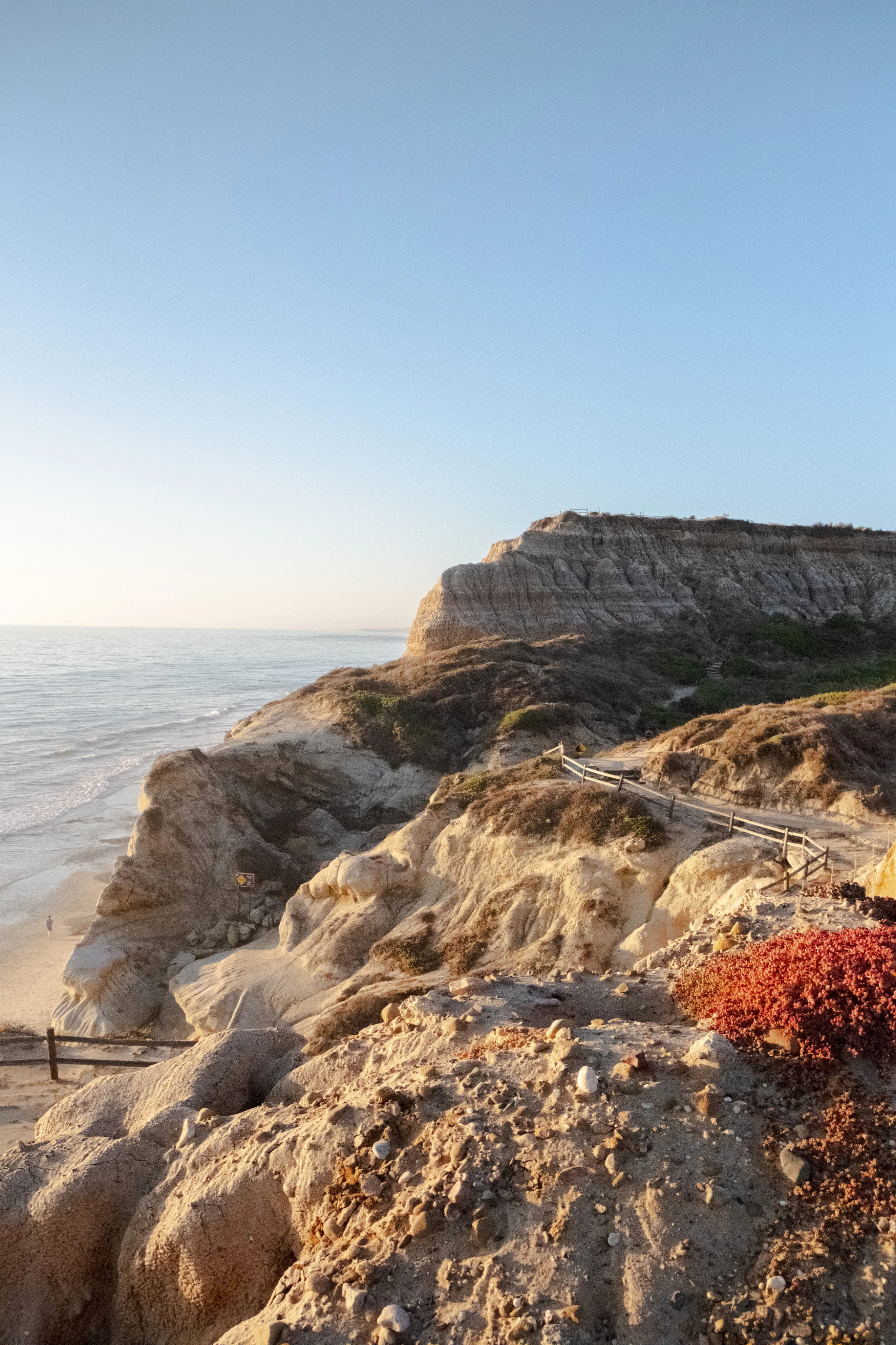
Sandstone bluffs, rare pines, and a long unbroken beach that reads "California" instantly. Important caveat: the Torrey Pines State Natural Reserve is state park land, and commercial photography and filming there require a permit through California State Parks. Drones are also prohibited in the Reserve, full stop. The beach below the bluffs is more flexible for small shoots, but if you're bringing a crew, ask first.
Coronado
Wide, flat, famously sparkly sand with the Hotel del Coronado as a backdrop and the downtown skyline visible across the bay. Coronado Beach is one of the best places in the county for clean, bright, open compositions — great for lifestyle and fashion work. Note that the Hotel del itself is private property; shooting with the building in your wide frame from the public beach is one thing, shooting on their grounds is another.
Urban locations
Gaslamp Quarter
Victorian facades, neon signage, and dense street energy — the closest thing San Diego has to a classic downtown film look. Nights here are genuinely cinematic. Weekend nights are also genuinely chaotic, so schedule accordingly.
Barrio Logan and Chicano Park
Chicano Park holds one of the largest collections of outdoor murals in the country, painted across the pylons under the Coronado Bridge. The scale is hard to convey until you're standing under it. Barrio Logan's surrounding streets add warehouses, taco spots, and working industrial texture. This is a neighborhood with deep cultural significance — shoot respectfully.
East Village rooftops
The high-rise boom gave East Village a real skyline, and several parking structures and rooftop venues offer elevated angles on Petco Park and downtown. Rooftop access is almost always private, so this is a location you arrange, not one you show up to.
Balboa Park
The Spanish Colonial Revival architecture along El Prado — the arcades, the California Tower, the lily pond — is the most ornate backdrop in the city. Because Balboa Park is city parkland with heavy visitor traffic, there is an established permit process for commercial photography and filming, and staff do check on larger setups. Early weekday mornings are the sweet spot for both light and empty walkways.
Liberty Station
A former naval training center converted into an arts district: long symmetrical arcades, courtyards, and clean mid-century lines. It's quieter than Balboa Park and the repeated architecture makes framing almost too easy. Much of it is managed property, so commercial shoots should check in with management first.
Desert and inland locations
Anza-Borrego Desert State Park
About two hours east of the city and worth every minute: badlands, slot canyons, ocotillo forests, and in good years a spring wildflower bloom that draws crews from all over. It's a state park, so commercial filming requires a permit and fee through California State Parks — build that lead time into your schedule.
Mission Trails Regional Park
Fifteen minutes from most of the city, Mission Trails gives you granite peaks, the San Diego River, and chaparral hillsides that pass convincingly for remote backcountry. It's my go-to when a client wants an outdoor look without a real travel day.
Mount Laguna
An hour east, at around 6,000 feet, the landscape flips to pine forest and mountain meadows. In winter it occasionally snows, which means you can shoot snow and beach in the same day — a genuinely useful trick for travel and apparel campaigns.
Permits and fees: what a small shoot actually needs
This is the part that stops most people. The good news: for a small crew with minimal footprint, the process is far less painful than people assume. Here's the general landscape — always check current requirements before your shoot date, because rules and fees change.
| Location type | Who issues the permit | Typical small-shoot reality |
|---|---|---|
| City of San Diego streets, beaches, parks | City of San Diego — Special Events & Filming department | Film permits are required for commercial work, but small crews with minimal equipment and no street impact often qualify for low-cost or no-cost permits. Apply ahead of time and describe your footprint honestly. |
| California State Parks (Torrey Pines Reserve, Anza-Borrego) | California State Parks film permit office | Commercial photography and filming require a permit and a fee. Lead times apply, so don't leave this for the week of the shoot. |
| Balboa Park | City of San Diego process (the park has its own permit desk) | Commercial shoots need a permit; casual personal photography does not. Larger setups, props, or blocked walkways raise the requirements. |
| Private property (rooftops, hotels, Liberty Station interiors) | The property owner or manager | Written permission from the owner. No city permit substitutes for this, and most managed properties have their own rate and insurance requirements. |
Timing your shoot
The marine layer is real. From roughly May through early July — locals call it May Gray and June Gloom — coastal mornings are often socked in with low clouds that may not burn off until midday. If you need blue sky at the beach in June, schedule for the afternoon or move inland, where the sun usually breaks through hours earlier.
Golden hour points west. Almost the entire San Diego coastline faces west, which means sunset is the show. Sunset Cliffs, Windansea, and Coronado all peak in the last 60–90 minutes of light. For soft light without the crowds, sunrise at the same locations is underrated — you'll trade the fiery sky for near-empty frames.
Weekdays beat weekends everywhere. A Tuesday morning at La Jolla Cove and a Saturday afternoon at La Jolla Cove are two different locations. If your production has any flexibility, shoot Monday through Thursday and you'll spend far less time waiting for backgrounds to clear.
Planning a portrait or brand session rather than a production? I keep a separate, deeper guide for that: San Diego photoshoot locations — the master list with spot-by-spot guides for Sunset Cliffs, La Jolla, Balboa Park, and Coronado.
Want these locations without the scouting work?
I scout, permit, and shoot at these locations regularly for brand campaigns, interviews, and content days. If you want San Diego's coastline, murals, or desert in your next project without figuring out the logistics yourself, take a look at my San Diego video production and product photography services, or get a flat quote — I'll tell you exactly which of these spots fits your brief.
