
Original snapshot: August 2026. Interpretation and limitations reviewed September 27, 2026.
Kanyon Studio’s original article reported a six-factor website-readiness review of 15 San Diego businesses across dental, med-spa, fitness, real-estate and restaurant categories. It was not a controlled test of AI answers. The aggregate scores below are retained as historical reporting, not current verified ratings of those businesses.
What the original report recorded
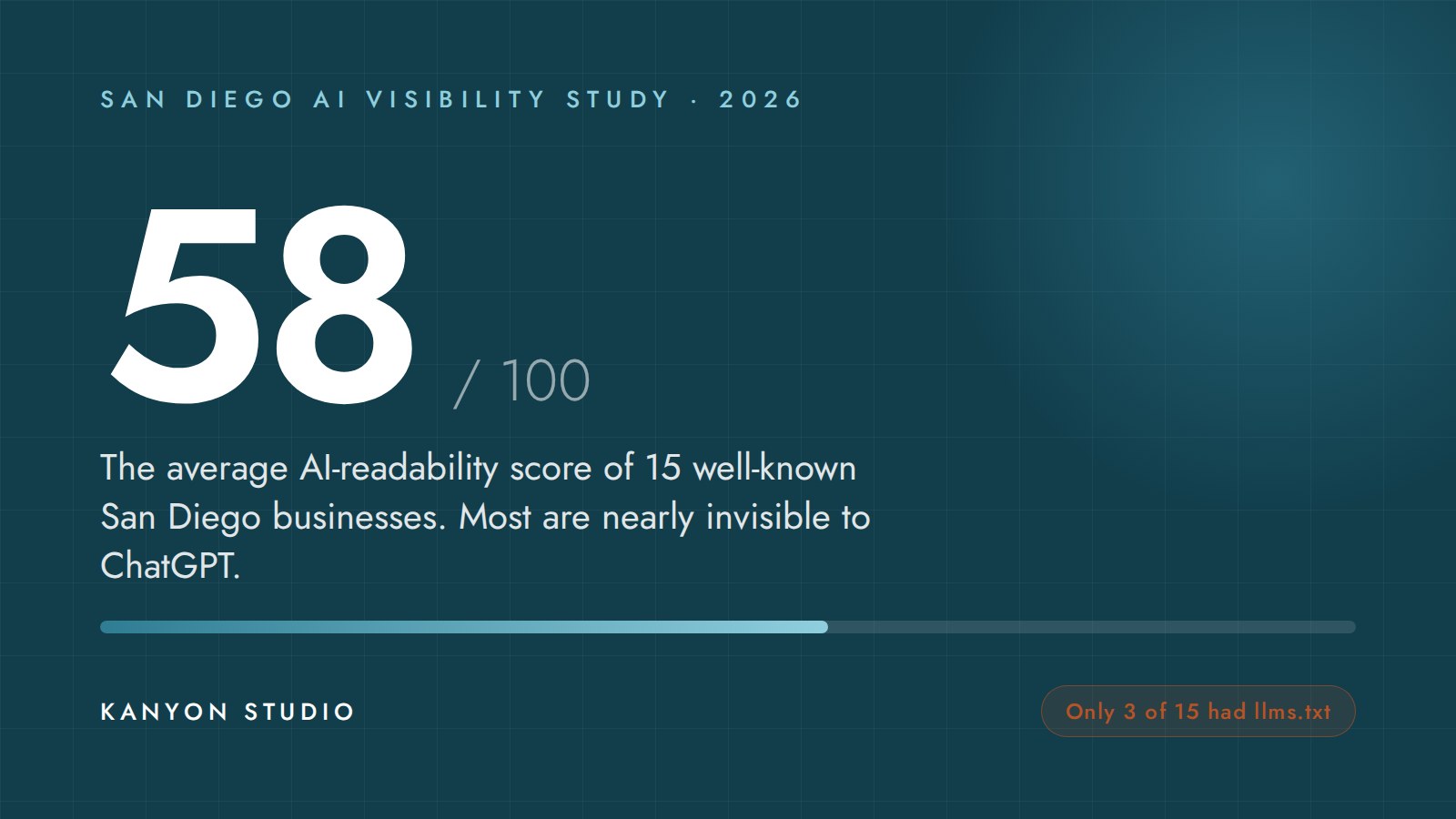
- Average score: 58/100; reported range: 15–85.
- 3 of 15 sites had a detectable llms.txt file.
- 4 of 15 had published pricing found in the review.
- 5 of 15 had FAQ content found in the review.
The original article did not identify the full sample or provide raw page captures. These aggregates therefore cannot establish a representative picture of San Diego businesses or support claims about an individual company’s AI visibility.
The original six-factor rubric
- Plain-language service and location clarity: 25 points.
- Page-title and description quality: 20 points.
- Published pricing information: 15 points.
- FAQ content: 15 points.
- Presence of llms.txt: 15 points.
- A clear booking or contact path: 10 points.
These are editorial audit weights, not weights used by a search engine. In particular, the llms.txt allocation does not establish that the file is necessary or worth 15% of actual search performance. A current tool version may use a different rubric and should not be compared directly without checking its methods.
What this measures—and what it does not
This is a technical website-readiness snapshot, not a test of how often ChatGPT, Perplexity or Google recommends a business. The score reflects the audit tool’s chosen checks and weights. Those weights have not been validated as predictors of rankings, citations or leads. A homepage scan can miss useful content on other pages or content loaded after JavaScript runs.
Missing FAQ markup, an llms.txt file or a particular schema type does not make a business invisible to AI. An unsuccessful scan also does not prove that an official search crawler is blocked. Different crawlers and browsing tools can receive different responses.
How to measure actual AI visibility
- Define the buyer questions, location, search-enabled engine and test date before running prompts.
- Repeat the same questions in independent sessions, without telling the engine to recommend your business.
- Save the complete answers and citation URLs. Count business mentions separately from links to the business’s own site.
- Check factual accuracy, especially prices, service areas and delivery terms. Record failed or inaccessible runs.
- Compare visits and qualified inquiries separately; a citation is not a sale.
This edition does not contain that prompt-based dataset. Its technical scores must not be presented as recommendation frequency or market share.
Sources and corrections
Google’s AI search guidance explains that ordinary search eligibility and useful content matter; no special AI text file or schema is required. llms.txt is a proposal for supplementary site information, not a ranking guarantee.
Clarified September 27, 2026: the original URLs and historical score lists are retained, but claims that low scores prove AI invisibility or that markup guarantees citations have been removed. The original article did not publish complete raw scan responses or a versioned scoring specification, so these historical numbers cannot be independently reproduced from this page alone. They have not been rerun or independently verified in this update.
Use the free technical-readiness audit to identify items for human review. For help prioritizing content and technical changes, explore Kanyon Studio’s search optimization service or send a project brief.